
.png)
Water Weaponised - Why Desalination Plants are Primary Targets in War
30 Mar 2026
By: Harriet Willars
Editor: Elijah Eaton
Editor-in-Chief: Grace Samuel
The views expressed are the author's own and do not reflect the views of the International Relations Society.
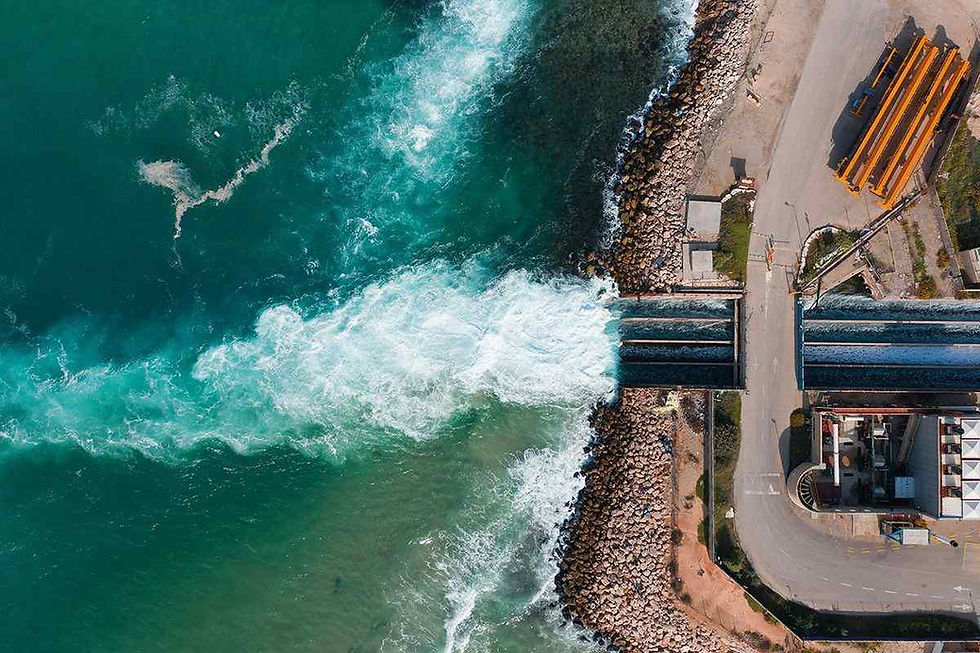
Bombed buildings and ambushed oil rigs make for familiar headlines. But the destruction of desalination infrastructure may be the most disturbing tactic of modern warfare. Nowhere is this more apparent today than in the turbulent Middle East, where access to clean water is quickly becoming a matter of survival.
Water has always been used as a weapon in conflicts dating back to ancient Greece. A particularly striking case occurred in 416 BC when Hermocrates, a Syracusan general, forced the Athenians to remain in a malaria-infested plain near Syracuse, leading to their defeat. Similarly, Operation Chastise (1943) during WWII saw British RAF bombers destroy German dams. The lesson was clear even then: control over water is a major form of political and military power.
Water sources have always been precious; their sabotage in times of war triggers a particular kind of destruction, one that is disproportionately felt by civilians. Although there is an abundance of water on the planet, it is unevenly distributed in space and time, with humid and arid regions as well as wet and dry seasons. These disparities have made the seizure and destruction of water sources a deliberate strategy of war.
Water scarcity is a defining feature of the Middle East and North Africa (MENA) region. Approximately 42 per cent of the United Arab Emirates’ drinking water comes from desalination plants, while that figure is 90 per cent in Kuwait, 86 per cent in Oman, and 70 per cent in Saudi Arabia. This shortage of abundant fresh water offers an opportunity for intervening states’ self-interests to be realised. We can see this unfolding now through the USA’s “preemptive” attack on Iran. Trump’s illegally waged war, supposedly aiming to “eliminate threats to Americans and allies from Iran and proxies”, has recently taken a water-destroying approach. Iranian Foreign Minister Araghchi accused US drone strikes on Sunday, 8 March, of “attacking a freshwater desalination plant on Qeshm Island”. It was later confirmed to have restricted water supplies to 30 villages.
Gulf states, in one of the harshest climates in the world, are heavily dependent on processing seawater to satisfy the needs of their growing populations. As such, desalination plants are perhaps the region’s most critical infrastructure. Without them, the region would be, for the most part, uninhabitable. The destruction of desalination plants paves the way for damaging and irreversible harm in the MENA region, with critical areas such as the Persian Gulf acting as a crucial supply for desalination. It is precisely this essentiality that makes them a target in warfare.
The MENA region, to satisfy the freshwater needs of its population in a naturally arid climate, as well as their history of being a destination for imperialism, played a major role in the initial development of large-scale desalination plants. It wasn’t until 1869 that the British government built a distillation plant in what is now Yemen in order to provide steamships passing through the Gulf and Red Sea with freshwater. One of the very first extensive desalination plants was constructed in MENA.
The deliberate targeting of water infrastructure is one of the most tactically cruel and strategically calculated forms of modern warfare. Where previous conflicts saw the systematic destruction of energy assets – namely, Operation Nimble Archer on 19 October 1987, in which United States Navy forces struck two Iranian oil platforms in the Persian Gulf — contemporary warfare has expanded this logic to encompass something far more immediately lethal: water itself.
Water infrastructure has been weaponised as an active theatre of conflict. The world is entering a new era of acute water scarcity, and armed conflict is rapidly accelerating that trajectory. As water stress intensifies globally, it creates dangerous asymmetries. Some nations will bear the consequences of a shortage far worse than others. This disparity itself becomes a geopolitical instrument. For states with the leverage to exploit it, water scarcity is not merely a humanitarian crisis to be managed but a strategic condition to be cultivated — a lens through which the United States' actions in the region may warrant closer scrutiny.


rr88 nhìn trên trang chủ là thấy họ làm bố cục khá gọn, kiểu các khối nội dung chia ra rõ ràng nên mình lướt một mạch vẫn nắm được đang nói đoạn nào; mình vốn hay khó chịu với trang nào nhét chữ dày đặc mà chỗ này đỡ hơn, kéo xuống cũng không bị đứt mạch, nhìn vẫn “ngay hàng thẳng lối” nên dễ theo dõi; có đoạn họ nhắc nền tảng vào thị trường từ 2018 và đặt trụ sở ở Philippines, mình đọc qua thấy ghi cụ thể vậy nên cảm giác thông tin có căn cứ hơn là kiểu nói chung chung; menu với mấy tiêu đề của các box trên trang chủ đặt khá…
Mình thường chỉ xem kết quả cho đỡ buồn tay sau giờ làm, coi như một thói quen nho nhỏ. Trúng hay không thì cũng hên xui, nhưng cái cảm giác ngồi chờ rồi so lại với con số mình nghĩ trong đầu vẫn khá vui. Hồi trước mình hay nghe bạn bè kể lại, nhiều lúc thiếu mất vài chi tiết nên sau này tự theo dõi cho yên tâm. Có dạo mình còn ghi chép mấy tuần liền để xem mình đoán theo linh cảm hay theo “cầu” gì không, rốt cuộc nhận ra đa phần là mình tự gán quy luật cho nó. Dù vậy, đọc mấy bài nhận định cũng giúp mình bớt ảo tưởng, biết…