
.png)
Kick-off: When the Match Began Before the Whistle
- Mollie Delhay
- Jan 25
- 4 min read
By: Mollie Delhay
Editor: Anna Pringle
Editor-in-Chief: Grace Samuel
The views expressed are the author's own and do not reflect the views of the International Relations Society.
Introduction
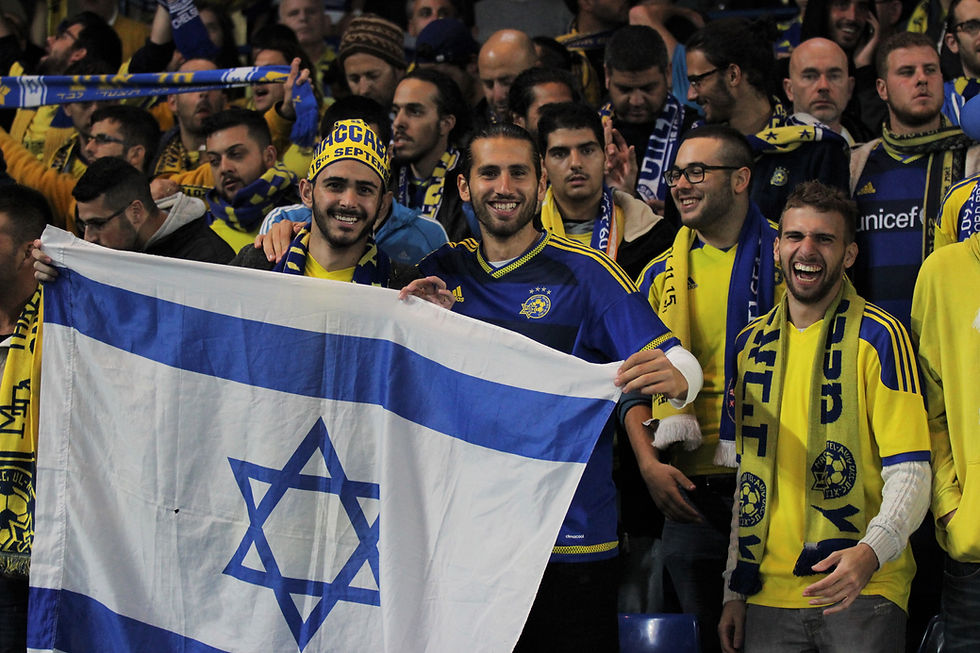
How much of politics is about trust? And how relevant is the public court of opinion? The recent game between Maccabi Tel Aviv, an Israeli football team, and Aston Villa, one of the many British teams, may suggest an answer. As a part of the UEFA Europa League tournament, the teams faced off on Thursday, 6 November 2025, at the Villa Park pitch. It was transformed headlines into an all-you-can-read buffet of geopolitical tension, violent arrests and questionable reactions. This match undoubtedly reflects the current dividing lines that the genocide in Gaza and the West Bank has created. It is a crisis that no longer involves just heads of state and their governments but has encouraged the political action of players used to a different kind of game.
Background Information
In October, concerns for public safety led to Maccabi Tel Aviv fans being banned from attending the match at Aston Villa’s home stadium. This announcement came in reaction to advice from Birmingham’s Safety Advisory Group who rely on intelligence from the West Midlands Police. It was considered that the biggest risk of violence were the extremist fans of Maccabi Tel Aviv. Police intelligence cited their sources well, recounting the events in which Maccabi fans had attacked Muslims in Amsterdam at a game last year. It involved around 5,000 Dutch police officers attempting to calm the violence and stop the “racist taunts” that surrounded it.
The current prime minister, Sir Keir Starmer, has since condemned this ban and suggested it a “wrong decision.” This is despite this ban serving as a clear example of the zero-tolerance approach to crime that Starmer’s government has both popularised and supported. Our political memory does not have to stretch far to remember Home Secretary Shabana Mahmood’s branding of protests as arrestable offences. Notably, Conservative leader, Kemi Badenoch, and Liberal Democrat leader, Ed Davey, have also criticised the decision of the West Midlands Police.
On the day of the match, this rising boil of political tension spilt over into 11 arrests made by the West Midlands Police, dominated by hate crime and racist abuse. Match officials were briefed on the day to prepare contingency plans, as over 200 protestors, both pro-Israel and pro-Palestine, surrounded the stadium.
Israel’s Role in UEFA
To some, the fact that Israeli teams such as Maccabi Tel Aviv are able to compete in the UEFA games despite being an Asian country makes this a senseless debate. Israel is located in the Mediterranean region, bordering countries such as Lebanon, Syria and Jordan. It has no direct claims to European geography, is not and has never been a part of the European Union. Israel’s only tie to the continent is political. With its history steeped in Western influence and Western assertion, from the 1917 Balfour declaration of a Jewish state out of British-owned Palestine, to modern trading patterns, in which Israeli arms rely on European countries, the connection to Europe is manmade. Relating this back to UEFA, the Israel Football Association (IFA) may be seen as a sign of Western interest within an Arab context. It was expelled from the Asian Football Confederation (AFC) in 1974 following a forced withdrawal from hosting in 1972, as the contempt for Israel in the Arab and Muslim nations meant they refused to play them. This culminated in the IFA beginning to compete in the European Intertoto Cup in the 1970s and 1980s, translating to UEFA allowing them to compete as an associate member in 1991 and then a full member in 1994. Currently, all Israeli national and domestic teams can compete in all European competitions.
Thus, it can be seen that the undercurrents of political strife felt in this game are not new. They are perhaps borne out of a much older, almost imperial, Western tradition of spreading European authority and ignoring the natural landscapes of our world.
Political Reaction within the UK
Furthermore, the aforementioned reaction of the biggest UK political parties to this ban may exemplify another political trend we are seeing. Their attempt at virtue signalling on issues seeks to equal their campaigning efforts. It is clear that Labour, the Conservatives and the LibDems all felt there was political currency to be gained from addressing the ban: a decision of a private football club. It is an issue that pales in comparison to those more salient such as the cost-of-living or the NHS waiting times. Though Davey addressed the West Midlands Police and Badenoch, the Home Secretary, it was Maccabi Tel Aviv that denied the sale of tickets to fans. Current political leaders seek to gesture to voters whose ‘side’ they are on. Moreover, the conflation of this ban with antisemitism only enables politicians to portray a moralistic stance on the decision and ignore the practical realities of security that are at play.
Critics have raised questions about whether those in office in particular should involve themselves. This case could be seen as a ‘contempt of court’ situation where any judgment - official or not - that is passed could bias the results rather than reveal a considerable truth. This is in reference to the Contempt of Court Act 1981 in which it is ruled illegal to publish articles about active legal proceedings in order to not prejudice its outcome. From these perspectives, UK politicians are increasingly led to rely on what voters think their values are, rather than what voters know their policies are.
Conclusion
In conclusion, as we return to our questions on trust and opinion, there is a wider view that this event is only a part of a global bleeding of political division into social relations. As much as we do not trust politicians, we now do not trust each other. Though the UK itself has a long history of football hooliganism, this concern of more politically-charged violence within the stands is an emerging change. The use of football as a vehicle for political expression is not to be ignored and may represent the situation of social cohesion or in fact social strain we are in. Whether political actors should invite further moral opinion onto this expression is to be considered by the reader.
Comments